
At a bank, applying a payment arrangement worked like this: the agent listened to the customer, wrote the deal down on a scrap of paper, handed it to someone in back office, who typed it into a spreadsheet, who emailed it to the operations team, who finally keyed it into the AS400 by hand.
Every handoff was a chance to lose the case. And cases were lost. Customers who had paid ended up reported to the credit bureaus. The regulator reviewed it and issued a fine of 300 million pesos.
Automating it — an interface between the collections system and the banking core — took 127 development hours on one side and 300 on the other. At the reference rates of the time, 32.7 million pesos.
The fix cost 11% of a single fine. And it still had to be argued before a committee.
That’s what this module is about: not how to have good ideas, but how a good idea turns into a project with a budget.
First: almost nothing you do is a project
The most expensive mistake in organizations is treating daily operations as if they were projects, and loose ideas as if they already were. These are three different things and they are managed differently.
| What it is | How to spot it | |
|---|---|---|
| Process | Linked tasks that turn inputs into outputs | It’s cyclical. It repeats. It doesn’t end. |
| Initiative | An idea under evaluation | No budget and no approval yet |
| Project | A temporary effort to create or change something | It has a start, an end, a scope and deliverables — and it sits outside normal operations |
Test it with six cases:
- Washing the dishes → process
- Approving and mailing credit cards to customers → process
- Wanting to buy a new TV → initiative
- Remodeling your house → project
- Taking the family to Disney → project
- Rolling out new customer service software → project
The TV is the one that invites the most argument, which is exactly why it’s the best example. As long as it’s a wish with no decision and no money allocated, it’s an initiative. The day you settle on a model, a budget and a date, it becomes a project.
Once it is a formal project, the PMI standard organizes it into five process groups: initiating, planning, executing, monitoring and controlling, and closing.
Second: a project that doesn’t hang off the strategy is an expense
Finishing on time and on budget isn’t success. It’s compliance. Success is generating value, and for that the project has to be tied to something bigger than itself.
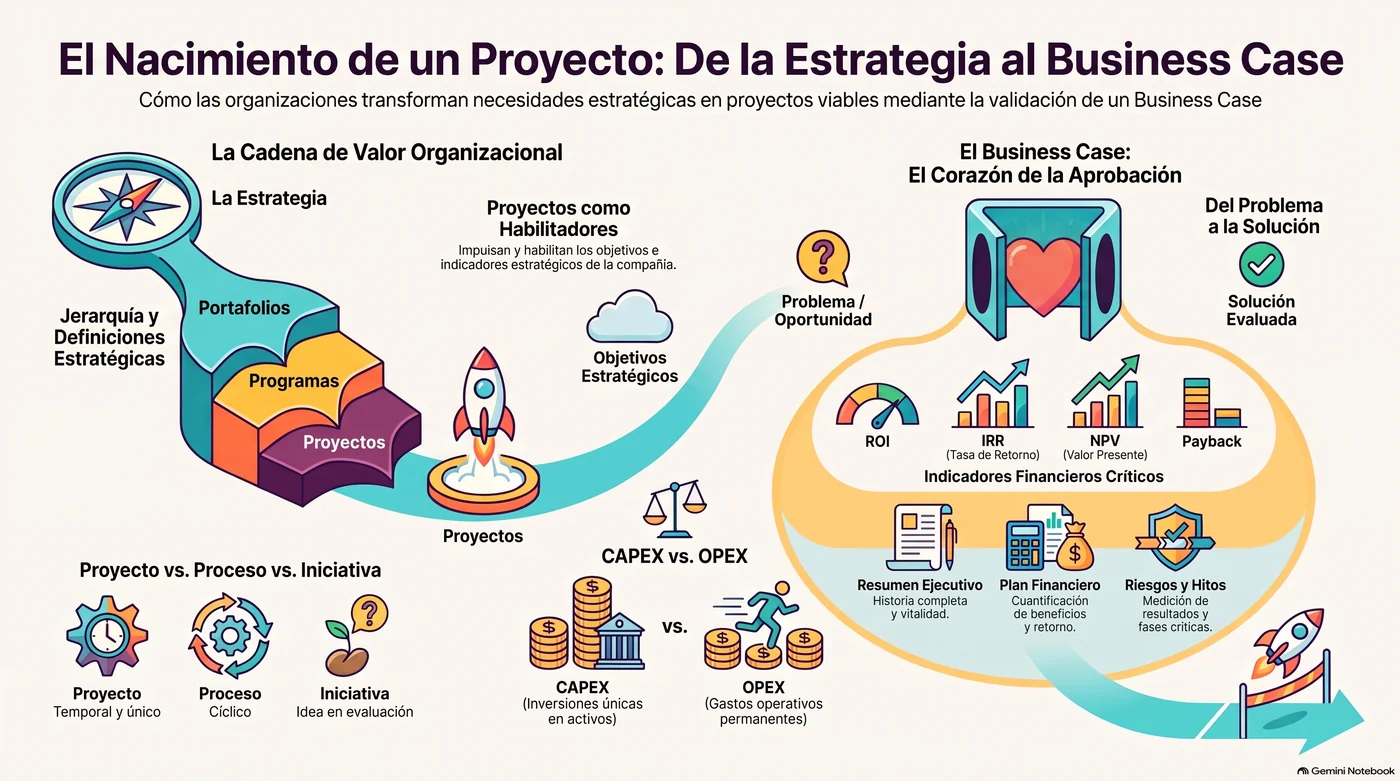
The cascade has four levels:
- Strategy — where the company is headed over the medium and long term.
- Portfolios — sets of projects or programs managed as a group to hit specific business objectives.
- Programs — groups of related projects run in a coordinated way, to obtain benefits you wouldn’t get managing them separately.
- Projects — the individual efforts that enable strategic objectives and indicators.
SpaceX makes it unambiguous:
| Level | At SpaceX |
|---|---|
| Strategy | Make humanity a multiplanetary species |
| Portfolio | Financial sustainability to fund the race to Mars |
| Programs | Starlink · commercial crewed spaceflight |
| Projects | Individual satellite launches · low-cost Rideshare missions |
Starlink doesn’t exist because satellite internet is exciting. It exists because it pays for the rockets. When someone asks what your project is for, the answer has to be able to climb that ladder all the way to the top.
Third: the road from idea to budget
Projects don’t just appear. They’re born from a problem, an opportunity, or a change the environment forces on you. And between the problem and the money there are five stops.
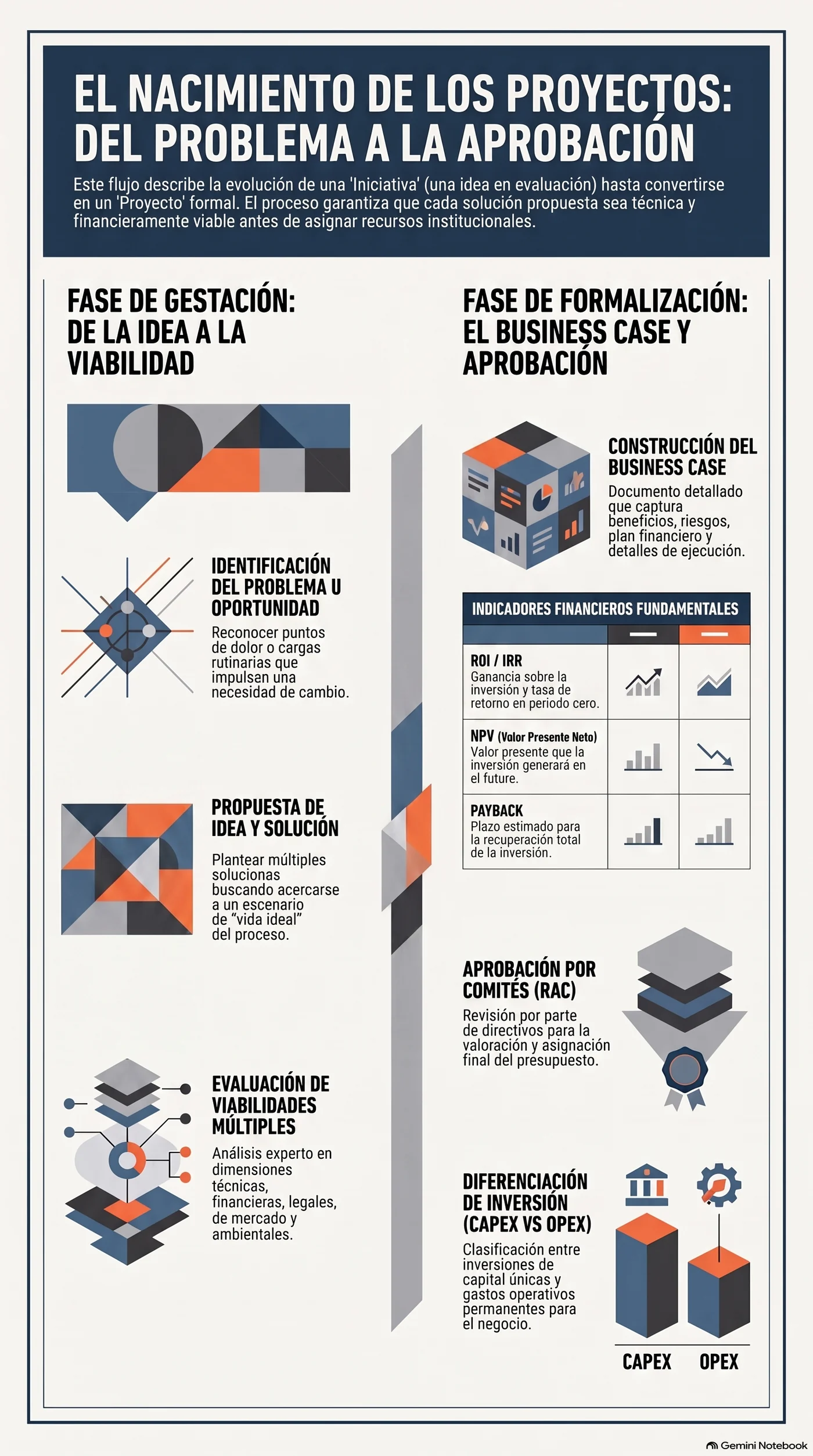
1. Identifying the problem. The signal is physical before it’s analytical: something became a burden, it slows the work down, it feels heavy, it’s routinely boring. That’s an improvement opportunity asking for permission to exist.
2. Proposing a solution. One problem yields several solutions, and the solution is almost always embedded in the problem. The useful exercise is to describe the ideal life of the process — what it would look like if it worked properly — and work backwards from there.
3. Assessing feasibility. This is where you bring in the experts: technical, financial, legal, market, environmental. It’s the stop where ideas that were only enthusiasm go to die.
4. Business case. The document that justifies the investment.
5. Approval. The committee that assigns budget based on priority, benefits and impact. In banking it’s usually the RAC committee. Whichever it is, you need to know who they are before writing the case, because the case is written for that audience.
Fourth: what a business case that passes actually carries
Seven pieces. None of them decorative.
Executive summary. Written last, even though it goes first. It has to carry the whole story: problem, solution, benefits, cost of execution, quantified benefits and risks. If someone reads it in two minutes and understands the idea, it’s well written.
Problem definition. What causes the pain point and what the impact on the organization is. In numbers, not adjectives.
Proposed solution. How your idea attacks the problem, what you need to implement it, what evidence you have that it would work, what alternatives you evaluated and which one you recommend. Showing up with a single option reads as not having looked.
Benefit capture. Concrete metrics: risk reduction, time saved, customer retention, competitive position.
Financial analysis. A six-year projection starting at year 0 — the investment year — with two separate buckets:
| What it is | Examples | |
|---|---|---|
| CAPEX | One-time investment in assets | Infrastructure, systems, equipment |
| OPEX | Ongoing spend to keep it alive | Licenses, support, operating staff |
That projection produces the four indicators the committee will be looking at:
| Indicator | What it answers |
|---|---|
| ROI | How much comes back on what was invested |
| IRR | The rate of return the project generates |
| NPV | What tomorrow’s money is worth today |
| Payback | How long until the investment is recovered |
Bring someone from finance in. A case with badly built numbers doesn’t get sent back for corrections: it dies.
Execution plan. Milestones, phases, pilot, go-live, soft launch, deliverables, estimated dates, dependencies, risks, and how results will be measured.
Craft recommendations. Assumptions get validated with the experts in the house, not invented. Look for examples of good and bad cases that have already been through that committee. Understand how your organization prioritizes. And write a draft and hand it to someone to tear apart before it gets torn apart in the room.
The challenge: build the collections case
Go back to the problem at the top. Here’s what you have:
| Development in the collections system | 127 hours × $45,000 = $5,715,000 |
| Development in AS400 | 300 hours × $90,000 = $27,000,000 |
| Total investment | $32,715,000 |
| Fine already imposed | $300,000,000 |
On the benefit side, the proposed process eliminates capture across multiple systems, loads accounts automatically, replaces email with maker/checker work queues, and opens reporting to every area instead of just customer service. In a comparable case that meant 120 seconds less per call — roughly 588 hours a month, four FTEs — plus retention and fewer complaints.
Your mission: prepare the arguments for the committee. And watch out for the easy trap. Justifying the case on the 300-million fine alone is weak, because the fine already happened: it’s sunk cost. The strong argument is the fine that hasn’t happened yet, plus the four FTEs freed up, plus the customers who stop getting wrongly reported to the bureaus. That’s where the recurring return is.
What to take with you
- Strategy is the compass; projects are the vehicles. If your project can’t climb the ladder to a strategic objective, it’s an expense with a schedule.
- Not everything is a project. Routine work is a process, an idea under evaluation is an initiative, and a project is only what’s temporary, unique and outside operations.
- The business case is where the budget is won or lost. Problem in numbers, solution with alternatives, quantified benefits, CAPEX and OPEX kept apart, and the four indicators.
- Fixing operational failures with projects doesn’t just save time: it avoids fines and protects the brand. The collections case cost 11% of a single penalty.