
In August 2002 a dollar cost 2,647.22 pesos. In August 2026 it costs 3,128.65. Twenty-four years to rise 481 pesos: under 1% a year.
That average is useless to everyone. Along the way the dollar fell to 1,744, climbed to 5,061, and came back down. Anyone who signed a dollar contract in 2008 and collected it in 2015 saw their peso income nearly double without lifting a finger; anyone importing machinery in 2022 paid 60% more than three years earlier for the same machine.
The interesting question is not what the dollar is worth. It is what moves it.
Four periods, four stories
| Period | Starting rate | Ending rate | Change |
|---|---|---|---|
| Álvaro Uribe · Aug 2002 – Aug 2010 | 2,647.22 | 1,826.31 | −31.0% |
| Juan Manuel Santos · Aug 2010 – Aug 2018 | 1,826.31 | 3,053.14 | +67.2% |
| Iván Duque · Aug 2018 – Aug 2022 | 3,053.14 | 4,422.77 | +44.9% |
| Gustavo Petro · Aug 2022 – Aug 2026 | 4,422.77 | 3,128.65 | −29.3% |
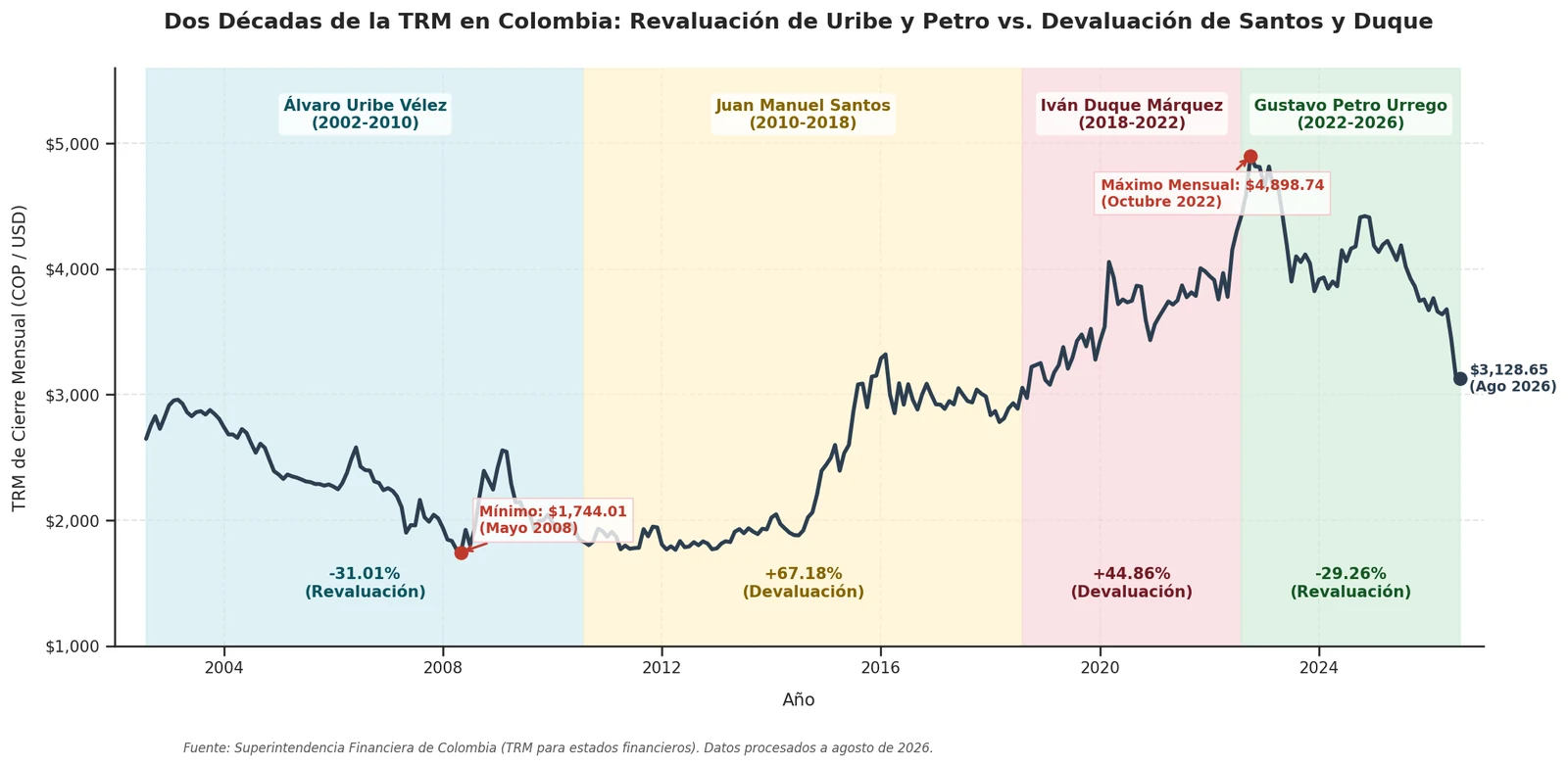
Two falls and two climbs, alternating. And here is the part worth looking at: that alternation does not match the political color of the governments. The peso strengthened under a right-wing administration and under a left-wing one, and weakened under the two in between. If the president were the explanatory variable, the pattern would look different.
What actually explains each stretch
2002–2010: the commodity supercycle. Oil and mining had their best decade in fifty years, and dollars poured into Colombia through exports and foreign direct investment. When many dollars come in, the dollar gets cheaper: plain supply and demand. The rate touched 1,744.01 in May 2008, the low point of the period.
That came with a cost few people mention: with a cheap dollar, exporting manufactured or agricultural goods becomes bad business. Industry and agriculture lost competitiveness while the country got used to living off oil.
2010–2018: the bill arrives. In mid-2014 crude prices collapsed. Colombia lost its main source of foreign currency and a large share of its fiscal revenue overnight. The dollar broke 3,000 pesos in 2015 and never went back below. This is the largest depreciation of the four periods, +67%, and no domestic political crisis caused it: a price set in London and New York did.
2018–2022: the perfect storm. The 2019 national strike, the 2020 pandemic — which pushed the dollar above 4,000 pesos for the first time — and, in 2021, the loss of investment grade. That last point is more technical than it looks, which is exactly why it matters: many international funds are barred by mandate from holding debt below investment grade. They do not choose to sell; they have to sell. That drains capital structurally, not out of panic.
2022–2026: the record and the correction. On 5 November 2022 the rate hit 5,061.21 pesos, the highest value in history. The market was pricing in fiscal and energy-policy uncertainty. Then came a 38% correction from that peak, for three reasons that stacked up: Colombia’s central bank held interest rates high — which makes it attractive to bring dollars in and invest them in pesos — the Federal Reserve paused its own, and the announced reforms reached Congress in milder form than the market feared.
The reading that is useful to a company
If the full series shows anything, it is that the exchange rate moves on forces no Colombian company controls, and they are almost always the same three:
- The price of oil, which determines how many dollars enter the country.
- Federal Reserve rates, which determine where the world’s capital goes.
- Country risk perception, measured in ratings and flows, not in speeches.
For anyone running a business, that has a practical consequence: currency exposure is not forecast, it is hedged. If you import inputs, carry dollar debt, or export, the right question is not “where will the dollar be in December?” but “how much can I absorb if it moves 30%?” Over the past twenty-four years it moved more than that four times.
And the obvious is worth repeating: a depreciation is neither good nor bad in the abstract. It helps exporters and people receiving remittances; it hurts importers, dollar-denominated borrowers, and anyone buying inputs abroad. In the same country, the same number is good news and bad news depending on who you ask.
Today’s rate, updated daily, is on the indicators page.
Two warnings for reading these figures
Both appear in almost every summary going around, and both are reading errors:
- 1,744 is not the dollar’s all-time low, it is the low of this period. In 1991 the rate was around 690 pesos. Comparing 1991 pesos with 2026 pesos without adjusting for inflation says nothing: the peso of thirty years ago was a different currency in purchasing-power terms.
- The 5,061.21 record is a daily rate, from 5 November 2022. Looking at month-end closes, the maximum is 4,898.74 in October 2022. Both figures are correct and measure different things: the daily one makes headlines, the monthly one goes into financial statements.
How this was built
The series is the month-end official rate certified by the Superintendencia Financiera de Colombia, the same one used to prepare and restate financial statements. Cut-offs were taken in August of each change of government, when the president is sworn in, rather than in December.
Changes are end-to-end: the last month’s value against the first. That makes the four periods comparable with each other, but it hides what happened in between — the 2022 record occurred inside the period that closes with a 29% appreciation. Which is why the chart matters as much as the table.
One note on the 2022 handover: July’s rate was 4,300.30 and August’s was 4,422.77. August is used here for both the close of one period and the start of the next, so the figures line up and no phantom jump appears.
This analysis describes what happened to the dollar and which factors moved it. It is not a forecast or investment advice.
Sources
- Historical exchange rate for financial statements — Superintendencia Financiera de Colombia
- Exchange rates and external sector statistics — Banco de la República
- Market Representative Exchange Rate, historical series — Colombia Open Data
- Record figures for the dollar in Colombia — Wilkinson PC
The series on YouTube
This topic has its own playlist on the channel: the videos in order, to watch end to end or pick up where you left off.